
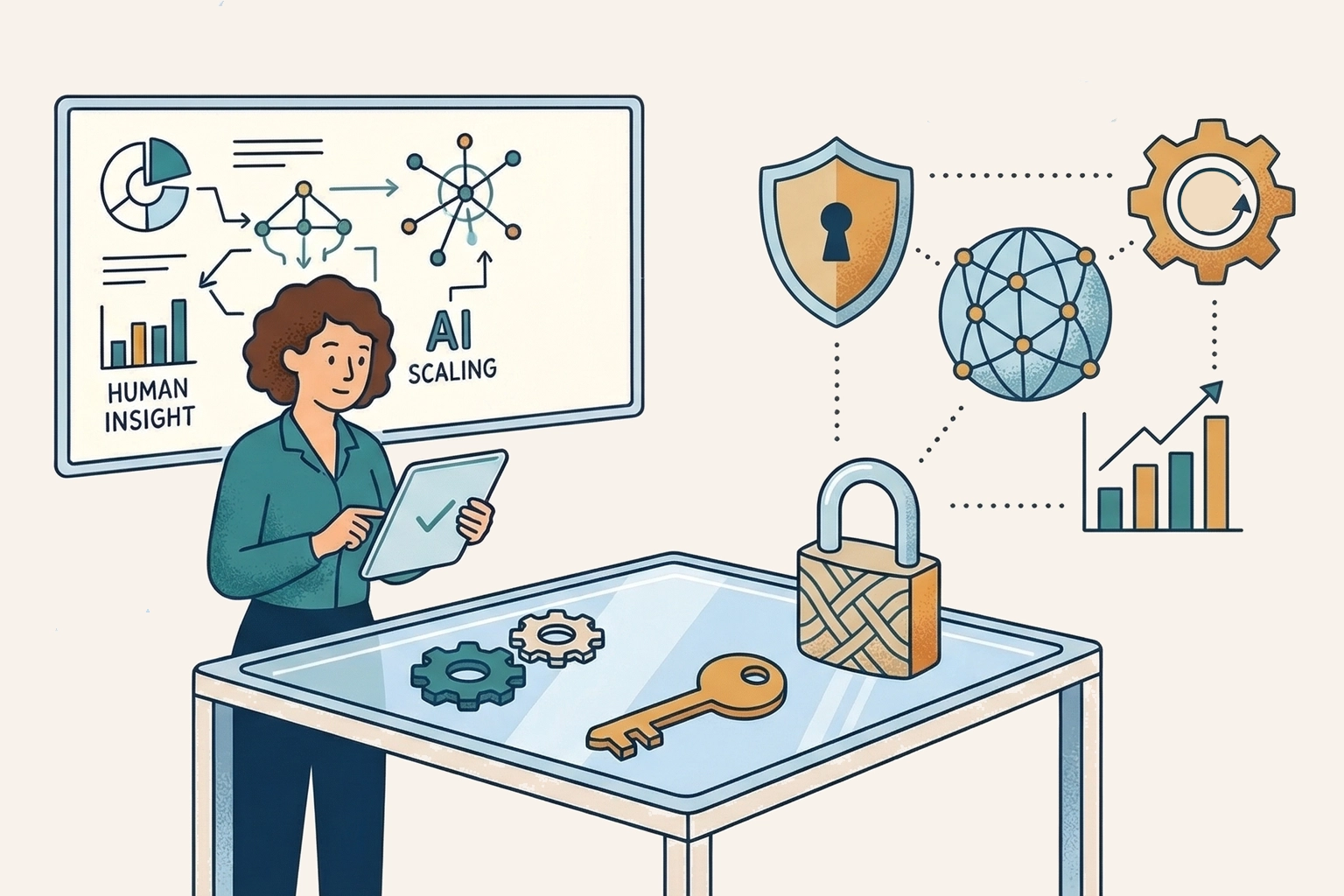
AI Is Getting Smarter. The Human Part Still Matters Most.
AI is getting better at more things, more quickly than most of us expected. It can summarize contracts, draft emails, and reorganize data in seconds. But it still can’t care about a client, navigate a moral grey area, or decide what “good” looks like for your team.
That’s the core finding of recent research from MIT Sloan School of Management on human-machine complementarity. Instead of asking “Which jobs will AI replace?” researchers ask, “Where does human capability matter most, and how can technology support it?” The findings are clear: the work that defines our organizations relies on empathy, presence, judgment, creativity, and vision. These are areas where humans are strongest and machines are weakest.
Braided is built around that same belief.
Replacing people with AI has never been our goal. We want to make sure powerful models stay in service of human thinking, not the other way around.
Collaboration Keeps Humans at the Center
Most AI tools are a single chat box. One person, one prompt, one answer. That setup quietly encourages the idea that the machine is the authority.
Braided takes a different approach. AI sits inside a shared workspace where people can see each other’s prompts, compare outputs from different models, and refine responses together. A researcher might ask a model for a first pass at a summary. A teammate can add context or flag what’s missing. A manager can layer in judgment about what really matters for the client.
The AI is fast, but the meaning, the tone, the priorities, the decision about what actually goes out, is decided by people.
That shared space matters even more when you’re working with multiple models. Braided lets teams run the same question through different AI systems and compare results side by side. One model might be more detailed, another more concise, another better at structure. Instead of treating any single model as the “source of truth,” teams use their own judgment and experience to decide which version fits the audience and situation. The technology generates options while humans choose, adapt, and make the call.
Transparency Gives Leaders Real Visibility
The MIT research study draws a clear line between automation and augmentation. Augmentation assumes humans stay actively involved in how tools are used. That can’t happen if AI use is scattered across dozens of untracked tools and private browser tabs.
In Braided, leadership can see how AI is being used across the organization. Conversations, agents, and outputs live in one governed environment. That kind of transparency reduces risk and creates conditions for real coaching. Managers can see where people are relying too heavily on AI, where they’re using it well, and where human skills like empathy or ethical judgment need to steer the output.
Instead of asking “Are people using AI?”, leaders can start asking “Are we using it in a way that reflects our values?”
Validate: Support Better Judgment
AI can sound confident even when it’s wrong. That’s dangerous when no one questions it.
With one click, Validate asks AI to double-check its own work: verify facts, revisit assumptions, or test the logic behind an answer. It doesn’t remove the need for human review. It gives people a structured, easy way to ask “Is this actually solid?” before they put their name on it.
The MIT researchers emphasize that opinion, judgment, and ethics are core human capabilities. Validate supports exactly that by making it natural to pause and question AI’s output rather than accepting it at face value.
Challenge: Encourage Critical Thinking
Good decisions rarely come from accepting the first answer.
One-click Challenge lets teams instantly generate counter-arguments or alternative perspectives. Instead of accepting a confident-sounding response, teams can apply the Socratic method and quickly see the other sides of an issue. It doesn’t tell them what to believe. It gives them material to weigh, tradeoffs to consider, and angles they might have missed.
The researchers note that moral dilemmas and complex judgment calls are exactly where AI falls short. Challenge builds structured disagreement into the workflow so that human judgment isn’t dulled by how fluent AI can sound.
Get Creative: Spark Your Imagination Without Replacing It
AI is great at remixing ideas. Humans are great at knowing which ideas are worth pursuing. Our Get Creative feature helps teams explore new ways to phrase an idea, different structures for a message, or fresh metaphors to explain a complex concept. But the spark, what feels right, what fits the brand, what will land with a specific audience, still comes from people.
The MIT framework highlights creativity and imagination as distinctly human capabilities that machines struggle to replicate. Get Creative puts AI in a supporting role, generating possibilities that humans evaluate, refine, and bring to life.
Why This Matters Now
The future of work belongs to teams that invest in human capabilities and smart tools that augment them. The demand for empathy, ethical judgment, creativity, and vision isn’t shrinking. It’s a growing need.
Braided is made for that future. Collaboration keeps people in the loop and in conversation. Multi-model access keeps AI in the category of “tools we choose from,” not “system we defer to.” Validate, Challenge, and Get Creative turn AI into something you think with, not something you hand decisions to. And leadership visibility makes it possible to invest in the very human skills that will matter more as AI continues to evolve.
AI will keep getting better at predicting words, summarizing text, and generating drafts. But the work of leading, caring, choosing, and imagining still belongs to your people. Braided is intentionally designed to keep it that way.
See Braided in Action
Want to see how Braided keeps humans at the center of AI? Start a free trial or reach out for a walkthrough of Validate, Challenge, Get Creative, and our collaborative workspace.